Filing Taxes in Germany: Who’s obligated to file tax returns?
Germany's tax system works on a pay-as-you-go basis: your employer deducts income tax (Lohnsteuer) from your salary every month. But that advance payment doesn't always match what you actually owe or what you're owed back. That's why Germany requires an annual income tax return (Einkommensteuererklärung) for many people. Not sure if you're one of them? Read on.
01
What Is a Tax Return in Germany
A tax return (Einkommensteuererklärung) is an annual declaration you submit to the German tax office (Finanzamt) to report your income and calculate your final tax liability for the year. Although employees pay income tax (Lohnsteuer) every month directly through their payslip, this is only an estimate. Your actual tax bill is settled once a year.
The result: many people have overpaid and are entitled to a refund. In fact, 9 out of 10 people who file a tax return in Germany get money back.
There are two types of tax return in Germany:
- Mandatory (Pflichtveranlagung): you are legally required to file
- Voluntary (Antragsveranlagung): you choose to file, usually to claim a refund
Tip:
On average, people who file a tax return in Germany receive a refund of around 1.240€. Even if you're not required to file, it's almost always worth it.
02
Do You Have to File a Tax Return in Germany?
For employees with a single employer and tax class I (Steuerklasse I), filing a tax return is generally not mandatory. Your wage tax covers your liability. But there are many exceptions, and they apply to a large share of people living and working in Germany.
If none of the mandatory criteria apply to you, you can still file voluntarily, and in most cases, you'll get money back.
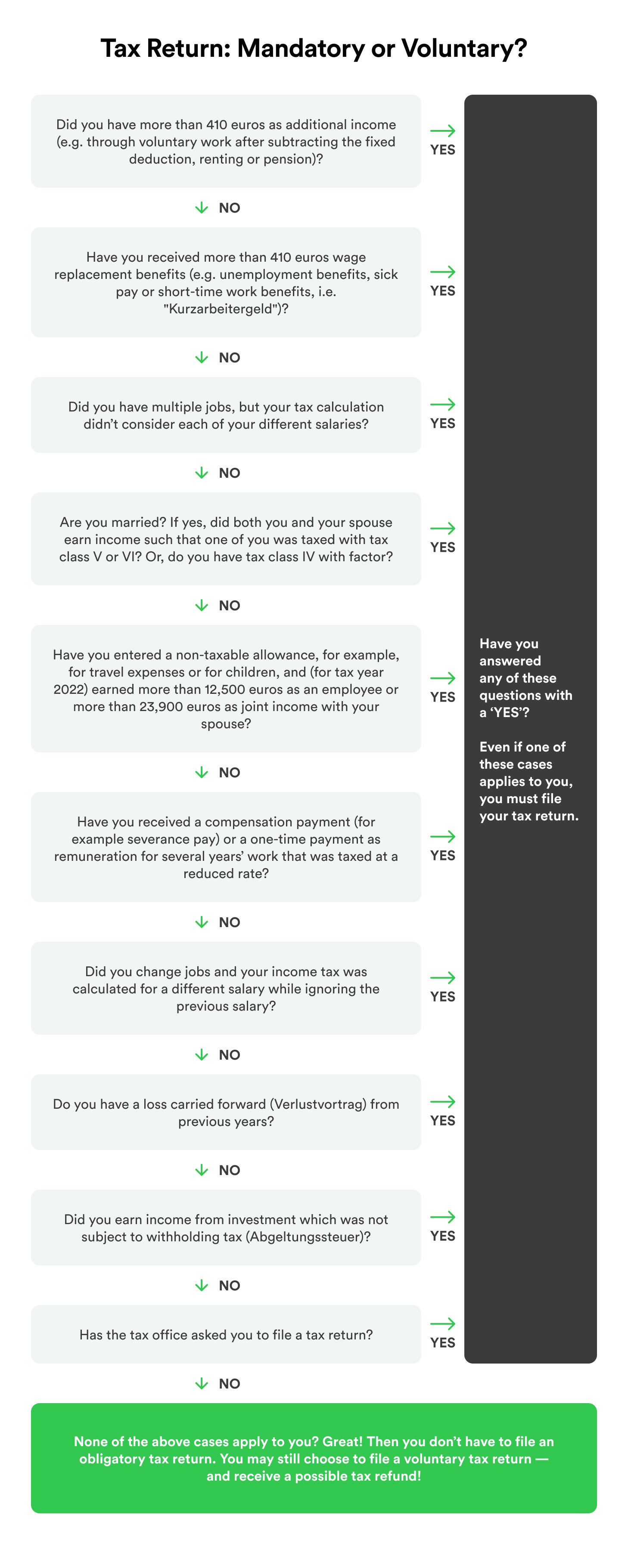
Tax Return Obligation Check
Find out in a few steps whether you are required to file a tax return.
Question 1 of 9
Have your positive income that was not subject to tax deduction exceeded €410?
E.g., through commercial secondary employment as an employee.
Do Foreigners and Expats Have to File Taxes in Germany?
Yes. Everyone who lives in Germany and earns income here is subject to the same tax rules regardless of nationality. If you're a resident (or have your habitual place of abode here), you are fully liable for German income tax (unbeschränkte Steuerpflicht).
There is one important exception to be aware of: if you also receive income from abroad, you may be subject to mandatory filing. Germany has double taxation agreements (Doppelbesteuerungsabkommen, DBA) with many countries to prevent you from being taxed twice, but you still need to declare the foreign income in your German tax return. It will typically be taken into account under the Progressionsvorbehalt (progression clause), which can affect your tax rate even if the income itself isn't taxed in Germany.
Mandatory Tax Return: When You Are Required to File
You are legally required to file an income tax return in Germany if any of the following applies to you:
Situation | Mandatory? | Why |
Self-employed / freelancer | Yes | Income is not taxed at source |
Two or more simultaneous employers | Yes | Tax class VI applies to second income |
Side income exceeding €410/year | Yes | Additional income must be declared |
Rental or leasing income exceeding €410/year | Yes | Income not covered by payroll tax |
Wage replacement benefits exceeding €410 (e.g. unemployment, parental allowance, sick pay) | Yes | Subject to Progressionsvorbehalt |
Married with tax class combination III/V or IV/IV with factor | Yes | Tax liability not fully settled via payroll |
Capital gains above €1,000 not taxed by bank | Yes | Withholding tax not applied |
Severance pay taxed via one-fifth method (Fünftelregelung) | Yes | Special taxation requires declaration |
Wage tax allowance (Lohnsteuerfreibetrag) entered | Yes | Actual expenses must be verified |
Tax office sends a formal request | Yes | Legal obligation regardless of other criteria |
Single employer, tax class I, no additional income | No | Payroll tax fully covers liability |
Married, tax class IV/IV, no additional income | No | Payroll tax fully covers liability |
Note:
The tax office (Finanzamt) does not always send you a reminder. It is your responsibility to find out whether you are required to file.
Details on the most common mandatory situations:
Side income above €410/year
Do you have taxable additional income from renting out a property, freelance work, or income from abroad? If the total from such sources exceeds €410 per year, you must declare it in your income tax return.
Wage replacement benefits (e.g. unemployment benefit, parental allowance, sick pay)
If you received more than €410 in wage replacement benefits during the year, such as Arbeitslosengeld I (unemployment benefit), Elterngeld (parental allowance) or Krankengeld (sick pay), you are required to file. These benefits are tax-free themselves but are subject to the Progressionsvorbehalt: they raise your effective tax rate on your other income.
Two or more simultaneous employers
If you work for more than one employer at the same time, your second employer will apply tax class VI (Steuerklasse VI) to your income. This means you are obligated to file a tax return.
Tax class combination III/V or IV/IV with factor
If you and your spouse or registered civil partner have chosen the tax class combination III/V, or IV/IV with a factor , you are required to file, provided the partner in tax class V has received wages. The same applies if you opt for individual assessment and have not applied for half of the training allowance or disability allowance for your child .
Wage tax allowance (Lohnsteuerfreibetrag) entered
If you applied for a wage tax allowance at your tax office and your income exceeds €13,150 (single) or €24,950 (married couples filing jointly) in 2025, you must file a return to verify your actual expenses.
Change of employer ('S' in the annual payslip)
If you changed jobs during the year and received special payments such as a Christmas bonus, your new employer may not have taken the previous employer's values into account. In this case, you will find the letter 'S' on your annual payslip (Lohnsteuerbescheinigung), and you are required to file.
Loss carried forward (Verlustvortrag)
If you have a tax loss from previous years, it is offset against your current taxable income. You must file a return to apply this.
Untaxed capital gains
If your investment income (from shares, interest, dividends) exceeded €1,000 and your bank has not yet deducted withholding tax – for example, because the account is held abroad – you must declare this.
Tip:
You can give your bank an exemption order (Freistellungsauftrag) to prevent withholding tax from being deducted. The savings allowance (Sparerpauschbetrag) is €1,000 per year (€2,000 for married couples). Capital gains above this threshold are taxable.
Voluntary Tax Return: When It's Worth Filing Even If You Don't Have To
Not required to file? You can still submit a voluntary tax return, and it's almost always worth it. You have up to 4 years to file retroactively (e.g., in 2026, you can still file for 2022).
Common reasons people get a refund:
- Home office deduction (Homeoffice-Pauschale): up to €1,260/year
- Commuting allowance (Pendlerpauschale): €0.38/km
- Work-related training and education costs
- Health and pension insurance contributions
- Relocation costs (especially relevant for expats moving to Germany)
- Double household costs (doppelte Haushaltsführung) — relevant if you maintain a home abroad
Not sure if you have to file?
Use Taxfix's free tax check to find out in minutes.
Your advantages
Taxes without forms: Answer our easy-to-understand question-answer process, or have your tax done by an independent tax advisor.
The best way to do your taxes
The choice is yours: complete the simple question and answer process with Basic, or use Expert and have your taxes done for you by an independent tax advisor. Either way, you can avoid complicated tax jargon.
Learn morePaperless document upload
Taxfix makes your tax return completely digital. Simply photograph or upload your documents. Taxfix then automatically transfers all important information - accurately and stress-free!
Learn moreGet an estimated tax refund quickly
We tell you how much you get from the tax office. Not only do we automatically deduct flat rates that you can use to save taxes, we also show you transparently what information you submit.
Learn moreCompletely secure
Your data is always transmitted in encrypted form to the Taxfix servers and via ELSTER to the tax office. We use secure encryption technologies that are also used by banks.
Learn more03
How to File a Tax Return in Germany: Step by Step
Filing your German tax return doesn't have to be complicated. Here's how it works:
- Gather your documents: You'll need your Lohnsteuerbescheinigung (annual employment tax statement), your Tax ID (Steuerliche Identifikationsnummer), your IBAN, and receipts for any deductible expenses.
- Choose your filing method: You can use the government portal ELSTER, a guided tax app like Taxfix, or a licensed tax advisor (Steuerberater*in).
- Fill in the correct forms: The main form is the Mantelbogen (cover sheet). Depending on your situation, you'll add Anlagen (annexes) for employment income, rental income, etc.
- Submit before the deadline: See the deadlines section below.
- Receive your Steuerbescheid: Once processed, the tax office sends you a tax assessment notice. If you're owed a refund, it's paid directly to your bank account.
Ways to File Your Tax Return in Germany:
Method | Best for | Available in English? | Deadline Extension? |
ELSTER (free government portal) | Tech-savvy filers comfortable in German | Partly | No |
Taxfix Basic | DIY filers who want a guided process | Yes | No |
Taxfix Expert | Anyone who wants it done by a licensed Steuerberater*in | Yes | Yes (until March 1, 2027 for 2025 return) |
Independent Steuerberater*in | Complex cases (multiple income sources, business income) | Varies | Yes |
Lohnsteuerhilfeverein (wage tax assistance) | Employees with straightforward returns | Usually German only | Yes |
Scan your payslip, and you're done!
It's so simple and completely digital: photograph or upload your documents. Taxfix then automatically transfers all important information. Accurately and stress-free!
Start for free04
What Documents Do You Need for Your German Tax Return?
- Tax ID (Steuerliche Identifikationsnummer): a permanent 11-digit number assigned to everyone registered in Germany
- Annual employment tax statement (Lohnsteuerbescheinigung) provided by your employer, usually in January
- German bank account IBAN for your refund payment
- Receipts for deductible expenses: home office, commuting, work-related training, professional equipment, etc.
- Health insurance contribution statements (Krankenversicherungsbeiträge)
- Rental income documents (if applicable)
- Foreign income documentation (if applicable), including proof of tax paid abroad
05
Tax Return Deadlines in Germany
Missing the deadline can result in penalties. Here's a clear overview for the 2023–2025 tax years:
German Tax Return Deadlines at a Glance
Tax Year | Self-filing Deadline | With Taxfix Expert / Tax Advisor |
2023 | September 2, 2024 (extended) | June 2, 2025 (extended) |
2024 | July 31, 2025 | April 30, 2026 |
2025 | July 31, 2026 | March 1, 2027 |
Voluntary return | Up to 4 years retroactively | — |
What Happens If You Miss the Tax Return Deadline?
If you are required to file and miss the deadline, the tax office can charge a late filing penalty (Verspätungszuschlag) of at least €25 per month (or part thereof) that the return is overdue, up to a maximum of €25,000. In serious cases, the tax office may also estimate your tax liability.
If you need more time, you can apply for an extension or use Taxfix Expert , which automatically extends your deadline by several months.
Tip:
Using a tax advisor or Taxfix Expert automatically extends your deadline by several months. There is no separate application needed.
How much does Taxfix cost?
You can use Taxfix from €39.99 or €99.99: Choose exactly the solution that suits you and your needs. Find our full pricing details on our costs page

Expert
Your personal point of contact
Your tax advice tailored to you and your case
Experts by your side
Contact your expert anytime
Error-free instead of paying extra
Have your taxes reviewed risk-free by licensed experts
Don't leave money on the table
Experts get you what you're owed
Extended filing deadline
March 1st 2027
Basic
Clear & fast
You handle everything step by step
See your refund in advance
First estimate, without guarantee
Save time
Carry over values from the previous year
Start
Calculate your refund for free
Find out in minutes what the tax office owes you.
Upgrade to Basic
Happy with the amount? File directly with Basic
FAQ: Filing Taxes in Germany
Not for everyone. If you are an employee with a single employer and tax class I, your wage tax typically covers your liability, and you are not required to file. However, many situations trigger a mandatory filing obligation, including having a second job, receiving wage replacement benefits above €410, being self-employed, or having income from abroad. When in doubt, use Taxfix's free tax check to find out in minutes.
Yes, the same rules apply to everyone living and working in Germany, regardless of nationality. If you are a tax resident in Germany (i.e., you live here or spend more than 183 days per year here), you are subject to German income tax. If you also have income from abroad, you are generally required to file even if that income is covered by a double taxation agreement (DBA).
For the 2025 tax year, the self-filing deadline is July 31, 2026. If you use a licensed tax advisor or Taxfix Expert, the deadline is extended to March 1, 2027. Voluntary filers have up to 4 years to submit retroactively.
If you are required to file and miss the deadline, the tax office (Finanzamt) can impose a late filing penalty (Verspätungszuschlag) of at least €25 per month, up to a maximum of €25,000. The tax office may also estimate your tax liability, which is rarely in your favour. If you need more time, apply for an extension or let Taxfix Expert handle it, which automatically extends your deadline.
The official government portal ELSTER is available partly in English, but the process can be complex. Taxfix is fully available in English and guides you through the process step by step.
Yes. If filing is voluntary (i.e., you are not required to file), you can submit your return up to 4 years retroactively. In 2026, for example, you can still file for the tax years 2022, 2023, 2024, and 2025. If filing is mandatory, you must meet the annual deadline. Late submissions may incur penalties.
A mandatory tax return (Pflichtveranlagung) is required by law when certain criteria apply, such as having multiple income sources, receiving wage replacement benefits above €410, or being self-employed. A voluntary tax return (Antragsveranlagung) can be filed by anyone who is not required to do so, typically to claim a refund. In both cases, the process is the same.
Processing times vary by tax office (Finanzamt) and time of year. On average, you can expect to receive your Steuerbescheid (tax assessment notice) within 4 to 12 weeks of submitting your return. Refunds are paid directly to your bank account, usually within a few days of the assessment. Filing early, ideally in February or March, tends to result in faster processing.
No, you don't. Many people file their own tax return. However, if your situation is complex, a licensed Steuerberater*in can be worth it. Taxfix Expert connects you with an independent, licensed tax advisor who handles everything for you, at a transparent price and with an extended filing deadline.
The average tax refund in Germany is around €1,072. Around 9 out of 10 people who file a tax return receive a refund. Even if you are not required to file, it is almost always worth submitting a voluntary return. You have nothing to lose and potentially over €1,000 to gain.
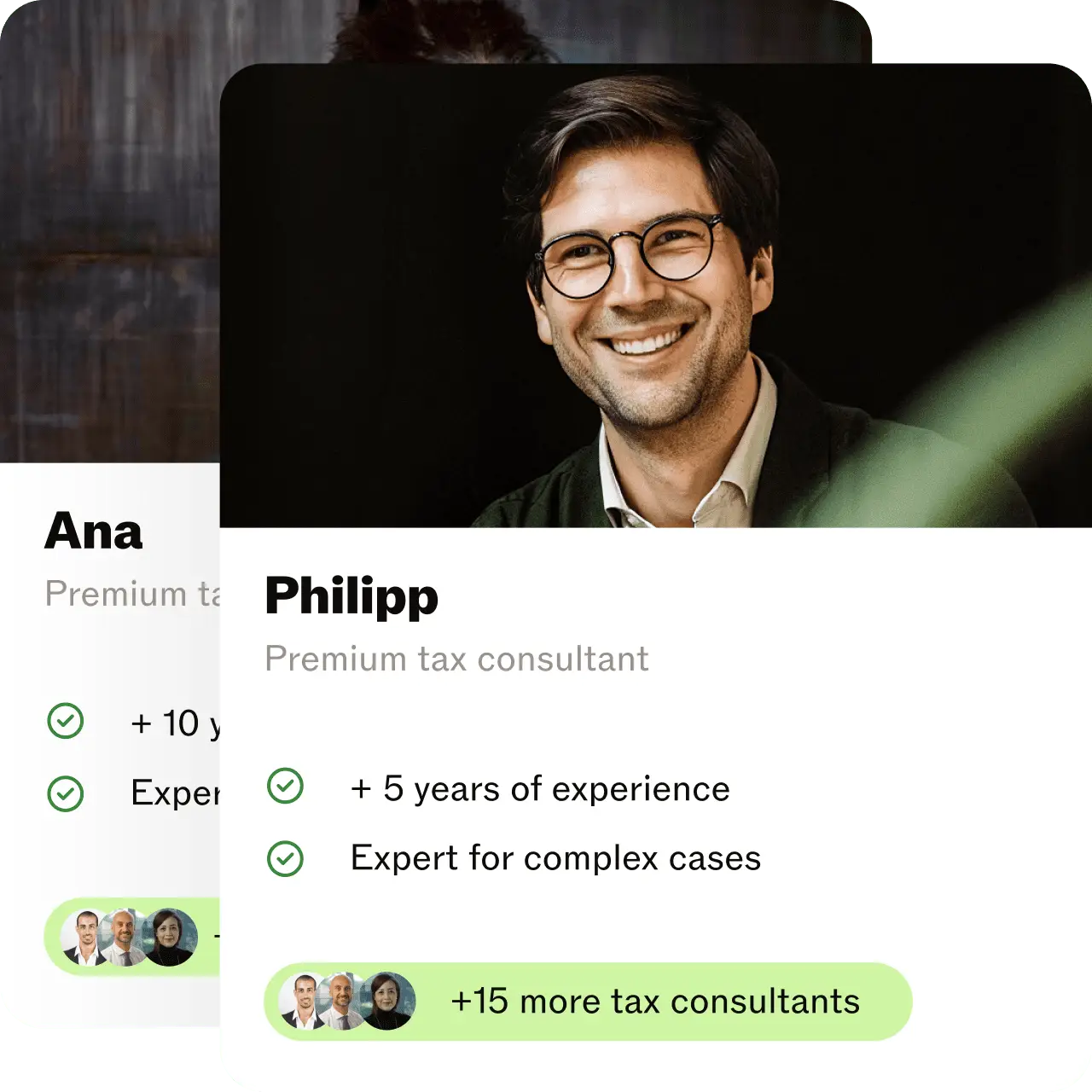
Our experts
You're in good hands
Our team of independent tax experts has years of experience helping people like you with your taxes.